Stepney
A three-volume account book kept by multiple generations of the Grave family, an array of primary documents, and stories passed down through the centuries allow us to envision the early inhabitants of the Deacon John Grave House, one of Connecticut’s oldest houses, dating to 1681. In addition to Grave family members, its residents numbered a series of enslaved persons. Among them was an individual named Stepney.
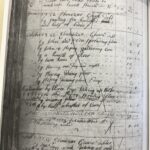
Between 1732 and 1762, the name “Stepney” appears regularly in the account book, which provides important information about the ways early Connecticut families made ends meet. For the Grave family, one of the ways appears to have been by profiting from the labor of a series of enslaved individuals. Throughout the decades he lived in the Grave household, Stepney can be seen performing an array of labor for local residents, with his enslaver charging others for that work. He appears to work alongside a succession of his enslaver’s sons, although as time goes on the names of the Grave children change, with older children moving on to different work, perhaps in their own households, and younger children taking over. The only name that doesn’t seem to change between 1732 and 1762 was Stepney.
The first record in which Stepney’s name appears was in October, 1732, where he is recorded gathering corn, work for which John Grave II appears to have billed a family member. Over the course of the next few decades, Stepney can be seen performing all manner of manual labor, including driving a plow, spreading flax seeds, digging stones, clearing land, making fences, building walls, and serving as an assistant to a mason. The final account book listing for Stepney appears in 1762, where he is listed as “fencing at High Hill.”
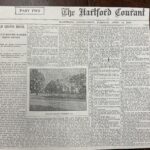
Even after he left the household, his name appears to have been physically immortalized in the house, where a steep stone staircase leading to the attic is, to this day, called “Stepney’s Stairs.” The staircase’s name appears to have stemmed from a story, passed down through the generations and recounted in a 1903 Hartford Courant article by Anne Kelsey Maher. “The old house not only sheltered successive generations of the Graves family but also numbered several slaves among its inmates,” Maher, a Grave descendant, wrote. “In the accounts … are frequent charges for work done by ‘Stepney,’ ‘Billie,’ and ‘Tomme.’ The present generation was always told that these were the names of negro slaves owned by the family. On one side of the great chimney is a flight of rough stone steps leading from a back chamber to the roof. These have always been called ‘Stepney’s stairs,’ and there is a tradition that he used them as a means of leaving the house by night, when going on expeditions for his own amusement.”