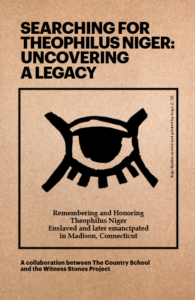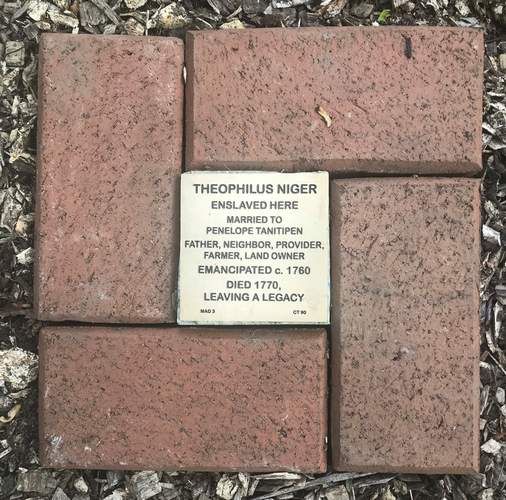
Theophilus Niger
Enslaved in what is now Madison, Theophilus Niger married Penelopy Tantipen, an Indigenous woman, in 1748, and together they started a family. In the 1751 will of his enslaver, Thomas Hodgkin, Niger was promised two plots of land. However, Hodgkin amended his will before he died, giving one of the plots to his nephew, Jedediah Coe, instead. Interestingly, shortly after Hodgkin’s death, Coe granted a parcel of property to Niger “out of “consideration of the respect and good will I have for Theophilus, a man, Negro, and servant.”
Niger also eventually gained his freedom. In her 1760 will, Abigail Hodgkin, Thomas Hodgkin’s widow, wrote that she was leaving property to “Theophilus, a negroe,” without mentioning that he was her “servant.” A land record written a short time later, confirms that by 1761 he was free. Filed in Guilford property records, the document shows “Theophilus, a free negroe” purchasing land from Phineas Meigs.
By that point, Niger’s wife, Penelope, and one of their children, William, had died, perhaps during an outbreak of smallpox. There does not appear to be a death record for Theophilus Niger, but Probate Court records show that on July 17, 1770, Jedediah Coe was named administrator of Theophilus Niger’s estate. His inventory included a house and barn and significant acreage, including fields, orchards, and forests. There is also an array of farming and fishing equipment, as well as woodworking tools. In one probate record he is listed as “Toffee Negro,” while another identifies him as “Theophilus Niger.”
His descendants would continue to use the surname Niger. Two of his sons, Philip Niger and Theophilus Niger, fought in the Revolutionary War. One of his grandsons, Alfred Niger, moved to Providence, RI, where he became a barber, Black voting rights advocate, and served as an agent for William Lloyd Garrison’s The Liberator. Alfred Niger named one of his sons Alexander Petion Niger, presumably after the first president of the Haitian Republic. Alexander Petion Niger is said to have been the first Black printer in Rhode Island.
Primary Sources

Project Documentation