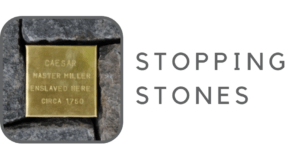

As you go about your day, whether on familiar streets or traveling through new spaces, you might notice something unfamiliar set into the ground: a square of granite topped with brass, bearing a name and a date. This is a Stopping Stone. Stopping Stones is a memorial project that honors enslaved people by marking the places where their lives unfolded—where they lived, labored, or worshipped. Unlike towering monuments, Stopping Stones do not rise above you or demand your attention. These micro-monuments invite attention through proximity; you encounter them only when you look down.
Each Stopping Stone records fragments of a life on small brass plaque set into a square of Vermont granite and installed flush with the ground. The stones are intentionally modest, designed not to dominate public space but to interrupt it quietly, almost privately, to inspire curiousity about the person whose name you see. The project draws inspiration from the Stolpersteine memorials first installed in Germany in the 1990s, which mark the last known residences of victims of Nazi persecution. Like those memorials, Stopping Stones are embedded in everyday life, ensuring remembrance is folded into routine rather than reserved for special occasions.
In much of the United States, particularly in the North, slavery is imagined as something that happened on Southern plantations, far removed from the streets we walk today. Stopping Stones unsettles that assumption. Based at Historic New England, the project places memorials in towns and cities that often believe themselves to be untouched by slavery. The stones make clear that enslavement was not abstract or peripheral. It happened here—in these houses, on these streets, in our communities.
Each micro‑monument represents a real person whose life may have been reduced to property or paperwork: a name in an inventory, a line in a ledger, a transaction in an archive. In some cases, an individual appears only once in the historical record—a brief notation in a probate inventory listing “a boy, aged twelve,” alongside livestock and household goods. Stopping Stones resists that reduction by insisting on visibility where erasure once prevailed.
The stones do not pretend to tell complete stories; they cannot. The archival record is too fragmentary, too uneven, too shaped by the priorities of those who held power. Instead, each stone marks a life lived in a specific place. It acknowledges that an enslaved person was here—and that their life mattered, even if history did not preserve much of their story.
The brass and granite used to make the stones signal durability, but permanence is not the project’s promise. Over time, the stones weather. They dull. They collect dirt. They require care. This, too, is intentional. Stopping Stones understands commemoration not as a finished act but as an ongoing responsibility. Community partners return to clean the stones, remove debris, and monitor their condition, sometimes years after installation. Tending the stones becomes an act of stewardship, a reminder that memory must be renewed rather than assumed.
This approach challenges the logic of traditional monuments, which often suggest closure: once the statue is raised, the work of remembering is done. Stopping Stones offers no such resolution. It asks communities to remain in relationship with the past, to return to the lives being honored, and to accept that remembrance, like care, is labor.
Education is central to the project’s work. Through its youth and school programs, students engage directly with the historical records of enslaved individuals. They examine census schedules, church registers, bills of sale, probate documents—records often incomplete or silent about the most intimate details of life. In working with these materials, students learn not only about the past but about the limits of what history preserves and whose stories are most likely to be lost. History, they discover, is not fixed. It is shaped by power, preservation, and omission.
By placing memorials in public spaces, Stopping Stones challenges the idea that history belongs only in museums or textbooks. The project shows that the landscapes people move through every day are historically significant, whether that history has been acknowledged or not. A familiar street corner, a churchyard, the site of a former home; each becomes a point of encounter between past and present.
Stopping Stones does not ask for awe. It asks for attention. It does not monumentalize suffering, nor does it offer easy consolation. Instead, it invites a pause—brief, unassuming, deliberate. The stones form a quiet network across neighborhoods and towns, linking communities through acts of remembrance that are local, relational, and sustained.
During Black History Month, the project invites reflection, but it also resists the idea that remembrance belongs to a single season. The invitation is often literal: to stop, look down, and read a name set into the ground. Memory does not adhere to a calendar. It is created through repetition: in returning to a place, in tending a stone, in telling a story again.
Stopping Stones leaves us with a question that is both simple and unsettling: When we pause in the places we pass through every day, whose lives do we choose to notice—and how will we carry that noticing forward?