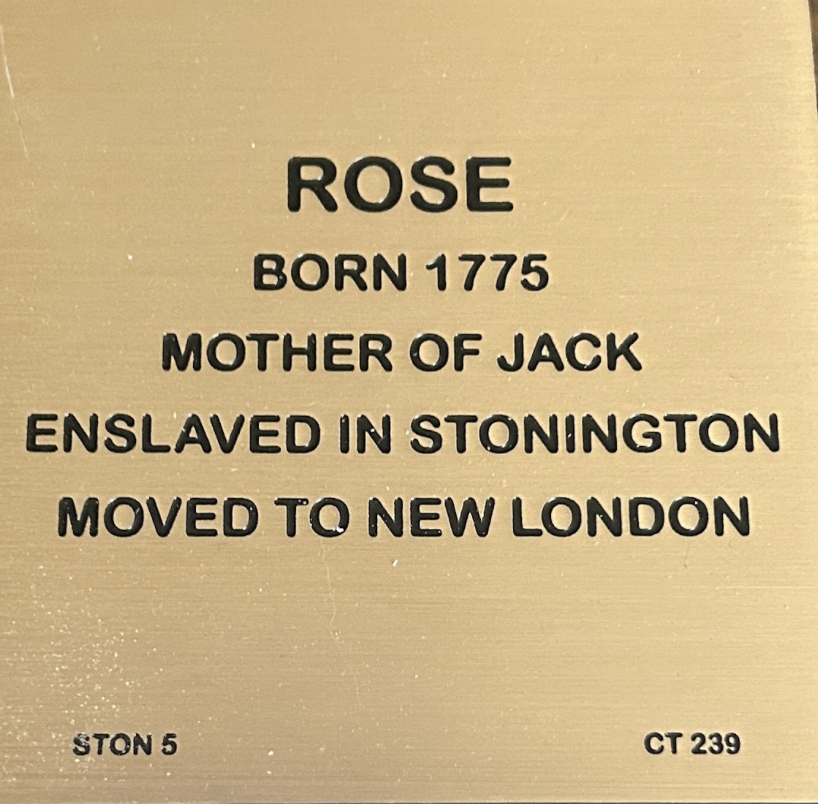
Rose
Born on Jan. 1, 1775, Rose was the mother of a boy named Jack, who was born in 1804. She may also have been the mother of a boy named Scipio, born in 1811. In 1807, Rose and Jack were both enslaved by Charles Phelps of Stonington, a physician and town leader, when Phelps chose to sell Jack, then about two-and-a-half or three years old, and lease Rose for five years to Ebenezer Stanton, a sea captain from Stonington who would soon move to New London. Because Jack had been born after 1784, when Gradual Emancipation was passed in Connecticut, he would legally gain his freedom at age 21, whereas his mother, born eleven years before the law was passed, would have been considered a “slave for life.” Based on the terms of the sale/lease agreed upon by Stanton and Phelps, Rose would have gone back to Phelps in 1812, while her son presumably would have stayed in the household of the Stantons. Rose’s and Jack’s fates were changed, however, when Phelps died in 1808 and Ebenezer Stanton died three years later, in 1811.
Rose likely remained with Stanton’s widow, but then at some point records suggest she may have moved to the household of Cyrus Williams, the son-in-law of Dr. Phelps, where a boy named Scipio,was born to a woman named Rose in 1811. The record does not show what became of her, though she may have been the older woman, also named Rose, who was named decades later in a dispute between the towns of Ledyard and Stonington. Ledyard was helping to care for her, and because she was originally enslaved in Stonington, they were seeking to be compensated for the costs her care incurred. As for Jack, a mariner named Jack Stanton received a Seaman’s Protection Certificate in 1827. He was described as “Colored Man” about five feet tall. His age was 23 in 1827, meaning he was born circa 1804. Stonington was listed as his birthplace, but his residence in 1827 was New London. There are also several “Jack Stanton” listed on crew lists ships out of New London in the 1830s and 40s. Whether any represent the Jack who was the son of Rose,, we cannot know for certain.
Primary Sources